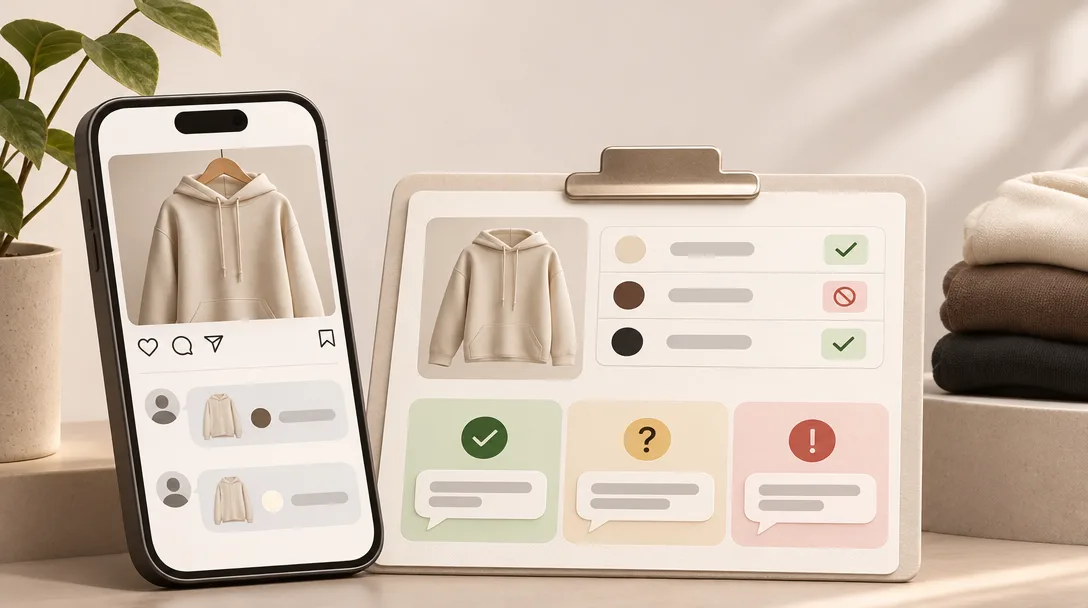
Instagram reply approval needs four checks: post fit, verified claims, brand voice, and whether a human decision is needed before posting.
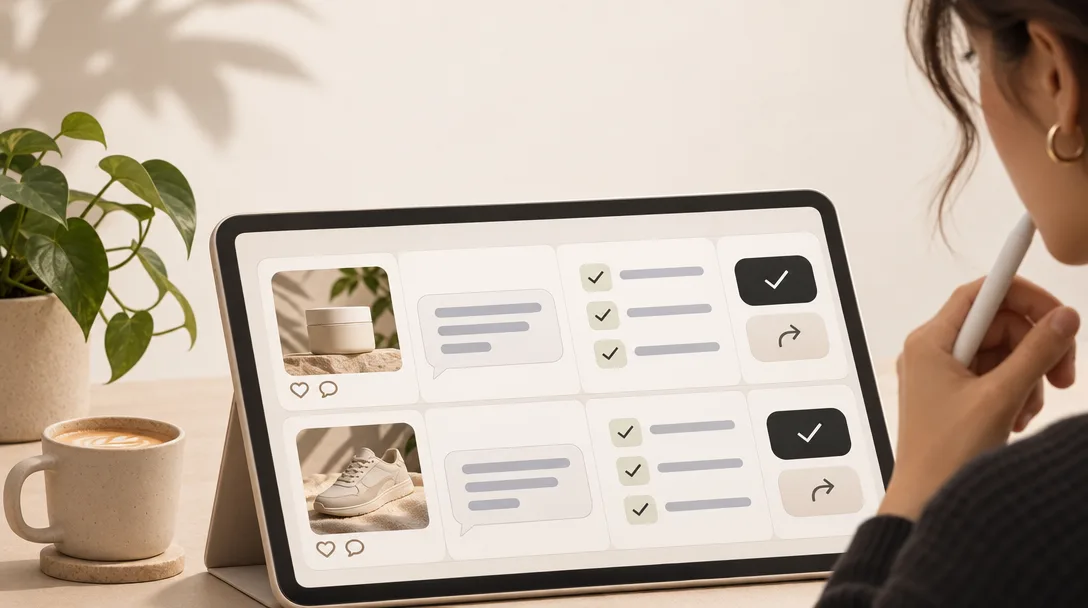
What should a brand manager check in the Instagram reply approval queue?
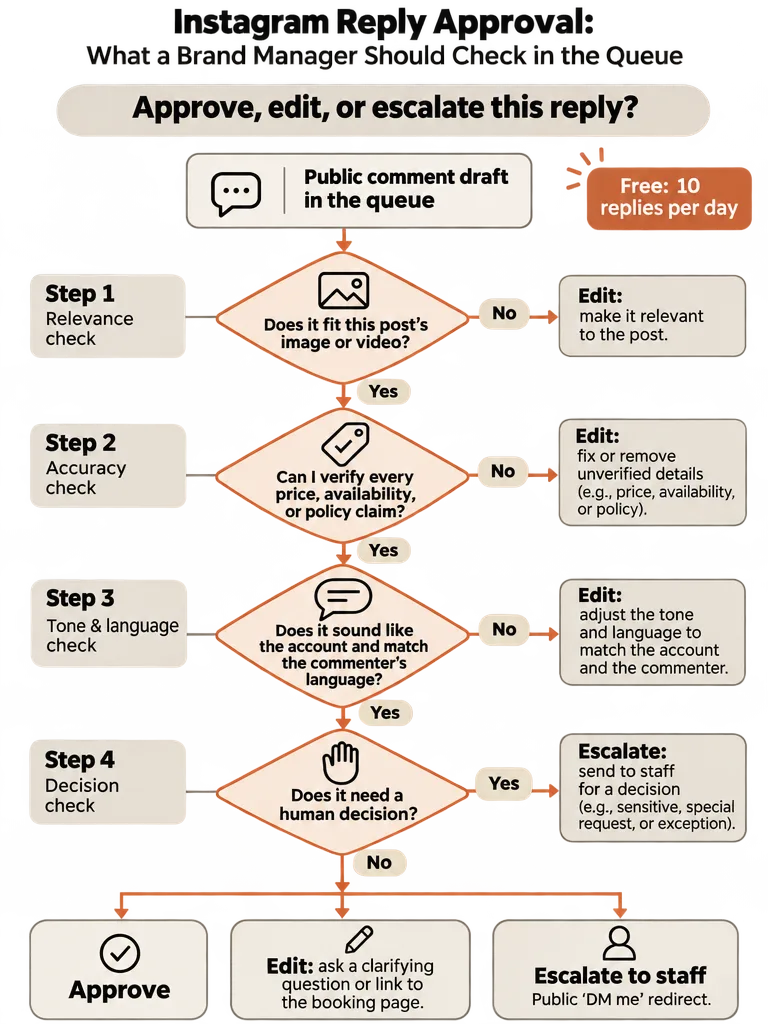
Instagram reply approval needs four checks before a queued public comment goes live: the reply fits this specific post, every price, availability or policy claim is verified, it sounds like the account, and it doesn't need a human decision. AI Hotel Agency says a person should check facts, numbers and promises in AI drafts.
Instagram reply approval is the step where a person reviews an AI-drafted public comment reply before it posts. This article covers public comments only, not DMs. One example of such a tool is ReplyMagic, which drafts replies after Google Gemini analyzes the post's photo or video, conditions them on the account's past replies, tone preferences, emoji habits and sign-offs, answers in the commenter's language automatically, and can suggest a “DM me” redirect, but is not a DM bot.
Tone is the last check, not the only one. A reply can sound perfectly on-brand and still promise a room that's booked.
The next sections run two labeled hypothetical posts through one worksheet. For every draft, write down four things:
- the claim the draft makes
- the evidence behind it
- the question still unresolved
- your decision: approve, edit or escalate
Scenario A: a room Reel and a comment asking “Is this free this weekend?”
Don't approve a draft that confirms availability or quotes a rate unless someone verified it against a booking source. A Reel shows the depicted room. It doesn't show that a bookable room exists this weekend. Post context tells you what the reply should talk about, not what is true today.
Hypothetical setup. A travel brand posts a Reel of its sea-view room. A commenter writes: “Is this free this weekend?” The AI draft reads: “Yes, the sea-view room is open Saturday and Sunday at $240 a night. Book now!” The $240 is an invented figure for illustration, not a real rate.
The draft does one thing well. It names the sea-view room, because the AI read the Reel's visuals, not just the caption. That's context, not triggers. But the brief for this article describes no booking-system connection, so “open” and the rate have no evidence behind them. Visual understanding is not live availability.
The comment is also ambiguous. “Free” can mean available or it can mean no cost. The draft assumed availability and then quoted a price anyway. Don't approve an interpretation the commenter hasn't confirmed, and get exact dates before anyone answers either question.
ERATBOT's hotel-inquiry guide separates understanding a request from verifying business information. It warns that a generic “Yes, we have rooms available” is a serious problem if availability hasn't been verified. AI Hotel Agency adds the rule for prices: don't state them, or availability, unless they come from the booking system.
Decision: don't approve the quote. Edit. Turn it into a clarifying reply: “Love this room! Could you tell us which dates you have in mind, and whether you're asking about availability or the rate? We'll point you to our booking page for live dates.” If you add a link, first confirm it goes to the official booking page. For how the post-reading step works, see how an AI reads each Instagram post before replying.
Scenario B: a knee-injury question and a payment-plan request under a wellness Reel. Approve or escalate?
Hold the draft and escalate. A comment asking whether a program suits a knee injury and whether a payment-plan exception is possible needs a health-suitability judgment and an unauthorized payment exception. Neither belongs in an AI-drafted public reply. The wording of a comment doesn't decide the answer. The post and the stakes do.
Hypothetical setup. A wellness studio posts a Reel promoting its movement cohort. A commenter writes: “Is this okay with a bad knee? Any chance of a payment plan?” The AI draft reads: “Yes, it's gentle on joints, and we can split the payment into installments!”
Compare it with Scenario A. Both comments ask “can I?” about something the post shows. In A, the missing piece is a verifiable fact, and the reviewer can point to a confirmed official booking page as the next step. A link is a next step, not proof of availability. In B, no link fixes the problem. The draft makes a suitability claim about someone's body and offers a payment arrangement nobody authorized.
ERATBOT lists staff-judgment cases: exceptions to policy, special rates, and conflicting requirements. AI Hotel Agency tells assistants not to promise discounts or exceptions, and not to give medical, legal or safety advice. A payment-plan exception and a knee question hit both lines at once.
Decision: don't approve. Escalate to staff. If you want a public response, post a short redirect: “Thanks for asking! The right answer depends on your situation, so DM us and the team will help.” That's the “DM me” redirect, and a person takes it from there.
This is a review habit, not professional compliance advice. The research here doesn't include verified medical or legal guidance, so your own professionals decide what a health-adjacent brand may say.
What if the price or availability can't be verified before you approve?
If the price or availability can't be verified, don't approve a quote. Approve a clarifying question, or a link to an official booking page you've confirmed, instead. A reply that says “check live dates there” is true. A reply that says “yes, and here's the rate” is a promise. A link is a next step, not proof of availability.
Here is the worksheet filled in for both scenarios:
| Proposed claim | Evidence | Unresolved question | Decision |
|---|---|---|---|
| “Reel shows a sea-view room” | The Reel's visuals show the depicted room | Is that room type currently offered? | Keep as a description only; this does not approve the rest of the reply |
| “Open Saturday and Sunday” | None in the draft | Did the commenter mean availability or cost, and which dates? | Edit: ask for dates and clarify |
| The invented nightly rate | None in the draft | What is the current rate for confirmed dates? | Edit: remove the figure |
| “Gentle on joints” | None | Who can judge fit for a knee injury? | Escalate |
| “Payment plan available” | None | Has the brand authorized exceptions? | Escalate |
Two sources disagree on what to do when a live check fails, and neither is a universal rule. Sellinger AI's Hotel Pirin playbook had its agent quote from live availability, or from the official rate card if the check failed. The check failed in 5 of 30 checked threads. All 5 totals matched on recomputation, though one missed a 3-night discount. Matching arithmetic is not the same as complete pricing accuracy. AI Hotel Agency says prices should be read in real time from the booking engine, or the reply should link to it.
Sellinger's agent answered email, Messenger and WhatsApp, not public Instagram comments, and it had live availability to check in the first place. It isn't evidence of what a comment-drafting tool can verify. For a public comment, the safer default is a confirmed link or a question. For how this plays out with booking questions generally, see how service businesses auto-reply to booking questions.
Does the reply still sound like the account, and is it in the commenter's language?
Check voice after the facts. Compare the draft with the account's established tone, emoji habits and sign-off, then confirm the commenter's language and that the meaning is right. A tone edit must leave dates, amounts and policies untouched. If you can't read the draft's language or verify what it says, hold the reply until someone who can reads it.
Drafts built from an account's real past replies, tone preferences, emoji habits and sign-offs still need this check. Voice conditioning doesn't verify facts. Two rules for the edit pass:
- Fixing tone must never change the facts. If you soften a sentence and a date or a figure moves, you've made a new claim. Re-run the worksheet.
- Language is automatic, not a per-post setting. The reply arrives in whatever language the commenter wrote in, so the reviewer may be approving text they can't read.
That matters for travel brands. At Hotel Pirin, 22 of 54 inquiries weren't in Bulgarian, per Sellinger. Confirm the dates, the amount and the policy in the draft, using a colleague or a translation check. For the full mechanism, see auto-replying to Instagram comments in your own brand voice.
When should a human take over instead of approving the reply?
A human takes over when a draft needs judgment the brand hasn't delegated: a substantive complaint, a health-sensitive question, or a discount, refund, exception or upgrade nobody authorized. Unresolved factual claims go on hold until someone verifies them. Spam, scam links, abuse and campaign entries can be skipped with no reply at all.
Escalate to a person when the draft:
- offers a discount, refund, exception or upgrade the brand hasn't approved
- responds to a substantive complaint
- touches a health-sensitive question
- contains conflicting details, such as two different dates or rates
Skip the reply when the comment is:
- spam, a scam link or crypto bait
- abuse
- campaign noise, like tag-a-friend entries
The publisher lists exclusion phrases, per-post settings and spam gates (which filter scams and link bait before AI is called) as the controls for this job. Filters cut both ways. Mimir's documentation warns that promotional-comment filters can catch genuine customer questions during campaigns, giveaways and live shopping. If comments seem missing, check the filtered views.
Before you hold a reply, ask what would make it safe to approve, and who supplies it. For a rate, it's the person who owns pricing or a verified booking link. For an exception, it's whoever has authority to grant it. For a health question, it's a qualified staff member. The research doesn't document handoff routing or assignment in any comment-reply tool, so decide that process inside your team.
How do you know when to stop approving every reply?
Review every draft first; approve only verified replies. Consider auto-send only for a repeat question whose answer never changes. Few edits and a stable answer are signals, not a universal release threshold. Keep verification, exclusion safeguards, ongoing checks and retesting after any change. The longer tradeoff is in approval queue or full auto.
Good candidates are questions like “where do I book?” Prices, exceptions and sensitive topics stay in review.
AI Hotel Agency recommends testing an assistant with 50 to 100 real questions before launch and after every change, and periodically rereading real conversations. That's a recommendation, not a measured benchmark.
Approval models also vary by tool. In Sprout Social, per its support documentation, one selected approver is enough to send a reply. That's a product-specific workflow, not a universal rule, so set your own sign-off policy.
The research here includes no primary Meta documentation, so this article makes no policy or account-safety claims. Check Meta's current rules yourself.
Frequently asked questions
Can I review AI-drafted Instagram comment replies before they post?
Yes, if the tool has an approval mode. ReplyMagic's approval queue holds drafted public comment replies so a person can review every one before it goes live. Auto-send mode is the alternative for obvious questions. The Free plan includes 30 posted replies per month, and Pro includes 3,000 replies per month.
Should I reply to both Instagram comments and DMs?
Yes. The hotel-marketing guide from xcale treats DMs as private booking enquiries that come first, while public comments can get a short reply that moves the conversation to DM. ReplyMagic covers only the public-comment side. It drafts comment replies and can suggest a "DM me" redirect for sensitive questions, but it is not a DM bot.
Can AI errors in Instagram replies be eliminated completely?
No. AI Hotel Agency says errors can't be removed 100%, but a complete knowledge base, clear limits, connected data and human checks greatly reduce them. For public comments, that means a person verifies every price, date and promise in a draft before it posts, because customers hold the brand responsible for what it says.
Which Instagram comments don't need a reply at all?
Spam, scam links, crypto bait, abuse and campaign noise such as tag-a-friend entries can go unanswered. Mimir's documentation advises deciding in advance what gets a reply, because answering everything is how genuine questions get buried. In ReplyMagic, exclusion phrases, per-post settings and spam gates handle this, with spam gates filtering scams and link bait before AI is called.
Can spam filters hide real customer questions on Instagram?
Yes. Mimir's documentation warns that automatic promotional-comment filtering occasionally catches genuine customer questions, especially during campaigns, giveaways and live shopping, when real comments look promotional. If comments seem missing, check the filtered views, such as Spam or Ads, and mark misclassified comments correctly so the filter handles similar ones better next time.
How many test questions should I run before turning on AI replies?
AI Hotel Agency recommends testing an assistant with 50 to 100 real questions before launch and again after every change. Include trick questions, such as asking about a spa the hotel doesn't have. Check every answer, then periodically reread real conversations. That is one agency's recommendation, not a measured benchmark.
Sources
- www.aihotelagency.comwww.aihotelagency.com
- eratbot.comeratbot.com
- sellinger.aisellinger.ai
- Instagram, Facebook and Messenger: Mimirhelp.trymimir.com