
AI Comment Replies vs. Keyword Auto-Responders: Which Converts More on Instagram in 2026?
Compare AI comment replies vs keyword auto-responders on Instagram. See what converts better, where triggers fail, and how ReplyMagic keeps control.

AI Comment Replies vs. Instagram Bots: What Is the Key Difference?
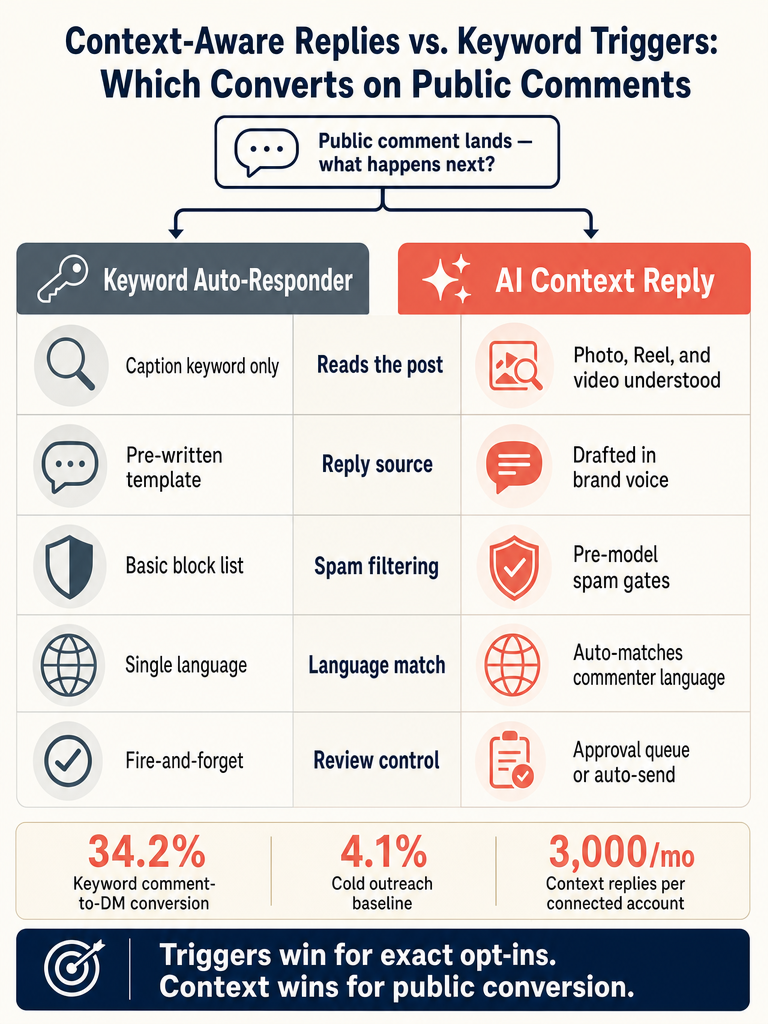
A keyword-rule Instagram bot sends a pre-written message when a comment contains a trigger word. An AI comment reply tool reads the post, reads the comment, and drafts a public reply in your brand voice. One is a trigger. The other is a response.
That distinction matters because Instagram comments are public. Shoppers read them before buying: according to Respondology, 68% of buyers scan comments on a post before making a purchase decision, and 47% associate the quality of the comment section directly with the brand itself. A robotic or wrong-post auto-reply is not a private misfire. It is brand copy sitting under your hero Reel.
The difference between a bot and an AI comment assistant is context, not triggers. ReplyMagic connects through Meta/Instagram OAuth, watches public comments in real time, and uses Google Gemini to analyze the post's photo, Reel, or video before drafting. The reply references what the post actually shows: not just what the caption said and definitely not just whether a comment matched a keyword.
| Capability | Keyword auto-responder | AI comment reply (ReplyMagic) |
|---|---|---|
| Trigger | Exact keyword match | Reads post + comment intent |
| Visual context | None | Gemini reads photo/Reel/video |
| Brand voice | Static templates | Conditioned on past replies, tone, emoji habits |
| Spam handling | Same rules fire on bait | Pre-LLM spam gates filter scams first |
| Wrong-post risk | High | Per-post analysis, per-post settings |
Which Converts More on Instagram in 2026: AI Comment Replies or Keyword Auto-Responders?
For public Instagram comment replies, AI wins on relevance and voice; keyword rules still win for simple opt-ins like "YES" or "GO." That is the honest answer, and the evidence requires the same honesty.
No supplied source publishes a clean head-to-head between AI public-comment replies and keyword auto-responders on Instagram. The strongest conversion data is adjacent. According to Inflowave, keyword-triggered comment-to-DM flows convert at 34.2% versus 4.1% for cold outreach: but that measures DM conversion, not public reply quality. Inflowave also reports AI-replied DMs trained on historical DM history convert at 7.6% versus 3.3% for static templates, a 2.3x lift. Again: DMs, not public comments. On Facebook ad comments, ReplyZen reports a govtech case where one AI agent lifted ROAS from 1.4x to 1.7x: a 21% relative improvement: over four months, posting 33,000 replies that drove 47,000 clicks.
On public Instagram comments, the variable that decides conversion is whether the reply makes sense for the specific post the shopper is reading. Keyword rules cannot read the post. AI comment assistants can. That is the lever.
| Job to be done | Better fit |
|---|---|
| Lead magnet opt-in ("Comment YES") | Keyword rule |
| Price, sizing, availability on a launch Reel | AI comment reply |
| Booking and cohort enrollment questions | AI comment reply |
| Same single CTA across one post | Keyword rule |
| Mixed-language comment thread | AI comment reply |
| Sensitive or order-specific question | AI reply with "DM me" redirect |
What Is Instagram Keyword Automation, and When Is It Still Useful?
Instagram keyword automation is rule-based behavior: if a comment contains an expected word, the tool fires a pre-written response or kicks off a DM flow. ReplyRush describes it cleanly: it "automatically sends a pre-written message when a user performs a specific action on your Instagram account." Spur frames the use case as moving inquiries to DMs the moment interest peaks.
Keyword rules earn their keep in narrow situations:
- Lead magnet drops. "Comment GUIDE for the free PDF" works because the keyword and the offer are one thing.
- Launch waitlists. A single keyword tied to a single signup link.
- Webinar registration. One Reel, one CTA, one trigger.
- Short opt-ins. According to Inflowave, short keywords like "YES" and "GO" outperform longer triggers by 22%.
Notice the pattern: one post, one CTA, one keyword. The moment a post has multiple plausible questions: price, sizes, shipping, booking: keyword automation breaks. And remember the conversion data celebrated for keyword flows is mostly about the comment-to-DM handoff, not the public comment reply itself. Keyword tools fire a CTA. They do not answer the actual question sitting in your comment thread.
Where Do Keyword Auto-Responders Fail on Reels, Launches, and Product Drops?
Keyword auto-responders fail the moment the same word means different things on different posts. "Price?" under a launch Reel needs a different answer than "price?" under a booking post. A keyword rule does not know the difference. ReplyMagic does, because it reads the post first.
The wrong-post problem shows up in predictable places:
- A viral Reel picks up comments meant for an older post, and the keyword fires the wrong offer.
- A product drop has sizes: the keyword rule answers "DM us!" instead of "We restocked S and M this morning."
- A cohort launch has enrollment cut-off questions; the trigger replies with the generic waitlist CTA the founder retired two weeks ago.
- A hotel availability post gets booking-window questions; the bot replies with the lead magnet from the last campaign.
- A service business post about pricing tiers gets "how much?": and the trigger sends the booking link without the price.
The recurring questions that punish keyword rules are exactly the ones that matter for revenue: price, sizes, availability, booking, enrollment, policies, cancellation, and shipping. Each one is post-specific. Each one needs the reply to know what the post is.
How Do AI Agents Automatically Respond to Social Media Comments? A Step-by-Step Workflow
AI comment agents work by reading the post and the comment together, then drafting a reply in your brand voice: with safety checks before anything is sent. Here is the ReplyMagic workflow end to end:
- Connect the account. ReplyMagic authenticates through Meta/Instagram OAuth to your Instagram Business account. No password sharing, no unofficial scraping.
- Watch comments in real time. Incoming public comments stream into ReplyMagic as they post.
- Read the post with Google Gemini. Before drafting, Gemini analyzes the post's photo, Reel, or video: so the reply references what the post actually shows.
- Run pre-LLM spam gates. Scams, link bait, crypto bait, and abuse are filtered before AI is ever called. You do not pay for replies to junk.
- Draft in your voice. ReplyMagic conditions the reply on your past replies, tone settings, emoji habits, and sign-offs from the connected account.
- Route by control mode. Send to approval queue (review every reply), review mode (spot-check), or auto-send for obvious recurring questions like price, sizing, and availability.
- Match the commenter's language. ReplyMagic replies in whatever language the commenter wrote in: automatically, no setting to toggle.
See how ReplyMagic drafts post-aware Instagram replies in your voice: Get started with ReplyMagic.
The mechanism that separates AI comment replies from keyword bots is post-reading: visual analysis happens before drafting, not after a trigger fires. Unauthorized bots simulate behavior outside the official API; AI comment tools authenticate through OAuth, operate inside Meta's published surface, and learn from brand history.
Should Instagram Comments Be Answered Publicly, Moved to DM, or Held for Human Review?
Answer publicly when the question is non-sensitive and shared by many shoppers. Redirect to DM when it is private, order-specific, or sensitive. Hold for human review when the comment carries risk. Most teams need all three lanes, not one.
Use this matrix as a starting point:
| Comment type | Best lane |
|---|---|
| Price, sizing, availability, shipping policy | Public reply (auto-send) |
| Booking windows, enrollment dates, cohort prerequisites | Public reply (auto-send or review) |
| Order status, refund, account-specific issue | "DM me" redirect |
| Health-adjacent or sensitive question | "DM me" redirect + review |
| Complaint, legal-sounding, ambiguous tone | Human review |
| Spam, scam link, crypto bait, abuse | Spam gate (never drafted) |
ReplyMagic exposes the controls by name: approval queue for total review, review mode for spot-check, per-post settings so a sensitive Reel runs stricter than a product drop, exclusion phrases that block automation on specific wording, and spam gates that filter before AI is called. For more on how this plays out during high-volume moments, see how ReplyMagic survives Instagram launches and whether AI can reply without flagging your account.
Can AI Reply in the Same Language and Still Sound Like Your Brand?
Yes. ReplyMagic replies in whatever language the commenter wrote in: automatically, not as a setting your team has to toggle. A French booking question gets a French reply. A Spanish "is this still available?" gets a Spanish answer. A Japanese comment under a travel Reel gets Japanese.
Brand voice survives the language switch because the conditioning is structural, not linguistic. ReplyMagic learns from your past replies, tone preferences, emoji habits, and sign-offs on the connected account. The tone settings travel with the reply regardless of the language it lands in.
This matters most for:
- Hotels and B&Bs answering booking and amenity questions across time zones.
- Travel creators whose Reels reach mixed-language audiences overnight.
- Global product drops where one Reel pulls comments in five languages.
- Service businesses with multilingual local markets.
What Is an Instagram Bot, and Why Is It Blocked? The Official-API Line
The word "bot" gets used loosely. The useful distinction: unauthorized bots simulate human behavior outside the official Instagram API; AI-powered comment tools operate through official APIs and learn from brand history. The first category is what Meta blocks. The second is what platforms like ReplyMagic build on.
ReplyMagic connects through Meta/Instagram OAuth and only handles public Instagram comments. It is not a DM bot. It is not an all-channel customer support suite. It is not unauthorized account simulation. The scope is narrow on purpose: public comments, official APIs, drafted in your voice.
The reason the scope matters is risk. Tools that operate outside official APIs sit in a different category from tools that authenticate through OAuth and work within Meta's published surface. When evaluating any Instagram comment tool, the first question is: does it use official APIs? If the answer is unclear, the answer is no.
How Should Creators, Coaches, Hotels, Services, and E-Commerce Teams Measure Better Conversion?
Stop measuring reply volume. Start measuring whether replies move people from comment to purchase intent. Volume is a vanity number: a keyword rule can fire 10,000 times and convert nothing.
Track these instead, segmented by Instagram-native use case:
- Response speed. Time from comment posted to reply visible.
- Answered-comment coverage. Percentage of comments that received a relevant public reply.
- Review queue override rate. How often your team rewrites the AI draft. A low rate means voice is dialed in.
- Spam filtered before AI. Pre-LLM spam gate hits. Direct cost saving.
- Click-throughs from comment threads. Public reply → link → action.
- Booking and enrollment questions resolved. Specifically the ones tied to revenue moments.
- Availability questions answered. See the cost of answering "is this still available?" forever.
- Confusion-to-intent moves. Comments that started as a question and ended with "ordered" or "booked."
Segment the dashboard by viral Reel, scheduled launch, cohort enrollment window, guest question (hospitality), service inquiry, and product drop. Each one has a different signal-to-noise ratio. A launch Reel will have repetitive price questions; a cohort post will have prerequisite questions. Measuring them together hides where AI is actually winning.
How to Choose an AI Instagram Comment Assistant With Safe Auto-Send
Before you turn on auto-send, the tool needs the controls to deserve it. Use this checklist when evaluating any AI Instagram comment assistant:
- Post-context analysis. Does it read the post before drafting? If the tool only reads the caption, it will fail on Reels.
- Visual understanding. Does it analyze photos, Reels, and videos: not just text? ReplyMagic uses Google Gemini for this.
- Official Meta/Instagram APIs. OAuth connection, not scraping.
- Approval queue. Option to review every reply before it sends.
- Review mode. Spot-check option for higher-trust posts.
- Per-post settings. Stricter rules on sensitive posts, looser on product drops. For the mechanism, see how ReplyMagic reads each Instagram post before replying.
- Exclusion phrases. Block automation on specific wording.
- Spam gates. Pre-LLM filtering of scams, link bait, and abuse.
- Brand-voice training. From your real past replies, tone preferences, emoji habits, and sign-offs.
- Same-language replies. Automatic, not toggled.
- Clear comment-vs-DM boundaries. Public reply tool with "DM me" redirects for sensitive cases: not an unauthorized DM bot.
| ReplyMagic plan | Replies | Instagram accounts | Price |
|---|---|---|---|
| Free | 10/day | 1 | $0 |
| Pro | 3,000/month | 1 | Pro plan |
| Extra account add-on | +3,000/month | +1 | +$15/month |
If your Instagram comment thread is the storefront: and according to Respondology, 47% of consumers judge your brand by it: pick the tool that reads the post, holds your voice, and gives you the controls to decide what auto-sends and what does not.
Ready to replace brittle keyword rules with post-aware replies in your brand voice? Get started with ReplyMagic and connect your Instagram account in a few minutes.
Frequently asked questions
Will an AI comment reply tool actually sound like me, or will it sound like a robot?
ReplyMagic conditions every reply on your real past replies, tone preferences, emoji habits, and sign-offs from the connected account: not a generic template. The voice travels across languages too: a French commenter gets a French reply that still sounds like you.
What happens to spam and scam comments: does the AI reply to those too?
No. Pre-LLM spam gates filter scam links, crypto bait, and abuse before the AI is ever called, so you don't waste replies on junk and none of that content gets a public response that looks like your brand endorsed it.
Can I review replies before they go live, or is it all automatic?
You choose the control mode: approval queue means you review every draft before it sends, review mode lets you spot-check, and auto-send handles obvious recurring questions like price, sizing, and availability. Per-post settings let you run stricter rules on sensitive posts.
When does a keyword auto-responder still make sense instead of AI?
Keyword rules earn their keep for a single-CTA scenario: "Comment YES for the free guide": where one word maps cleanly to one action. The moment a post draws mixed questions about price, availability, or booking, keyword rules fire wrong answers publicly and the case for AI context is clear.
How does the AI know what the post is actually about before replying?
Before drafting anything, ReplyMagic uses Google Gemini to analyze the post's photo, Reel, or video: not just the caption. That means a reply to a sizing question on a product-drop Reel references what's actually shown, not a generic script that could belong to any post.
How much does it cost to add a second Instagram account?
Each additional Instagram account is $15/month and includes 3,000 more replies per month: same pool, same controls, separate account. The Free plan covers one account at 10 AI replies per day, and Pro covers one account at 3,000 replies per month.
Sources
- Auto-reply to comments • Trigger DMs from keywords • Automate ...www.instagram.com
- Instagram Auto Reply to Comments (2026 Guide) - Spurwww.spurnow.com
- Instagram Auto Reply: How It Works & What's Allowed 2026www.replyrush.com