

How to Reply if a Customer Asks for a Discount
How to reply if a customer asks for a discount: restate value, ask one question, then use a soft no, alternative, or trade to protect margin.

How to Reply if a Customer Asks for a Discount
What to Say When a Customer Asks for a Discount
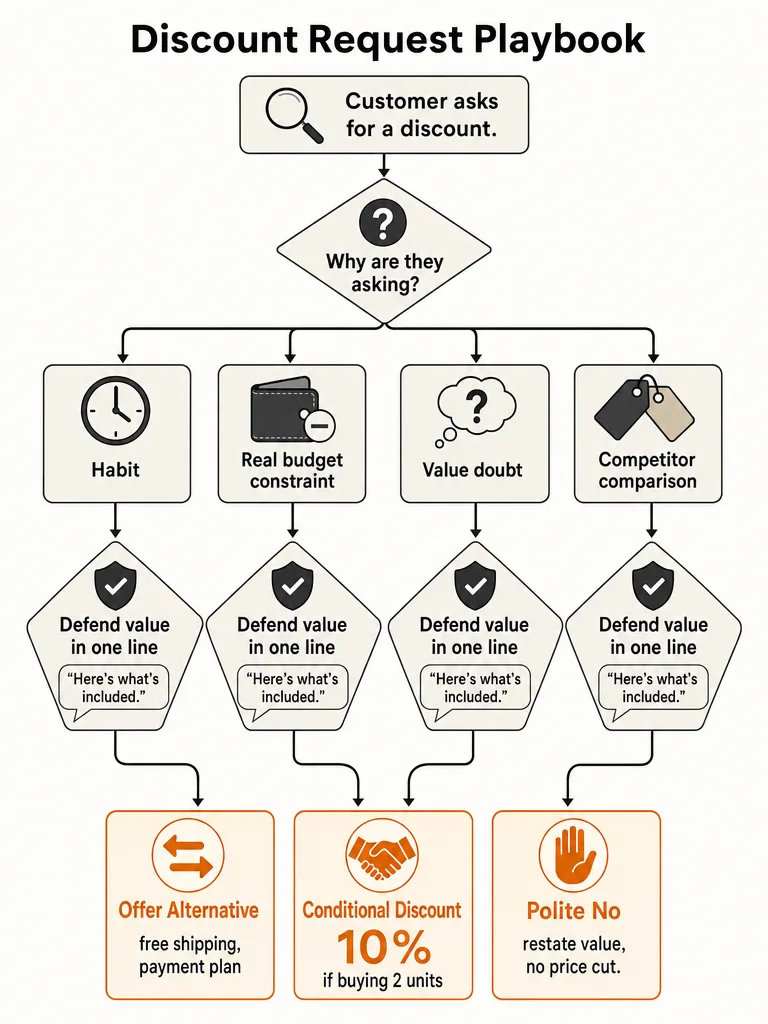
Don't drop your price the second someone asks. Acknowledge the request, restate the value they're getting, then pick one of three moves: offer an alternative, offer a conditional discount, or give a polite no. Caving immediately signals your original price wasn't real in the first place, according to Omnifox, which also notes that a flat no risks losing the sale entirely.
The fix sits between those two extremes. Lead with value, not price: "That's exactly why we include [benefit], [benefit], and [warranty]." Often, restating what's included makes the discount request disappear on its own. If it doesn't, you now have three honest paths forward instead of one reflexive concession.
Protecting margin while keeping the conversation open matters more than winning the exchange in one line.
Why Is the Customer Actually Asking for a Discount?
Customers ask for discounts for four different reasons, and treating them all the same wastes margin. Omnifox breaks the motivations into habit, value doubt, real budget, and competitor comparison, each requiring a different reply. Diagnosing the reason before you respond changes what you say next.
Cost sits at the center of most objections a business hears. SalesFuel reports that 37% of sellers cite cost-related concerns as a top objection, with 34% citing "the price is too high" and another 34% citing "buyers don't have the budget."
| Motivation | What it sounds like | Best response angle |
|---|---|---|
| Habit | Asks by default, no real hesitation | Restate value, no concession needed |
| Value doubt | Doesn't see why it costs what it costs | Explain what the price includes |
| Real budget | Wants it, genuinely can't stretch further | Ask their number, offer an alternative |
| Comparison | Found it cheaper somewhere else | Contrast what's included, don't match blindly |
A habit-driven ask and a real-budget ask look identical in a comment thread. The only way to tell them apart is to ask.
How Do You Politely Respond to a Customer Asking for a Discount?
A polite reply acknowledges the request, restates what the price includes, then asks one clarifying question before offering anything. Skipping straight to a discount or a refusal answers the wrong question, since you don't yet know if this is a habit ask or a real budget constraint.
The structure, drawn from HubSpot's and Omnifox's response frameworks, works in three steps:
- Acknowledge without apologizing. "I hear you, that's a fair question."
- Restate the value. "Our price reflects [quality/warranty/support]."
- Ask before offering anything. "What matters most to you here?" or "Is budget the main thing standing in the way?"
Omnifox frames the defensive version this way:
"I hear you. Our price reflects [quality/warranty/support]. What matters most to you? Let me show you why it's worth the investment."
This keeps the conversation moving without committing to a number you might regret. It also gives you the information you need to pick the right path from the three above.
How Do You Say No to a Discount Request Without Losing the Customer?
A firm no works better paired with a concrete alternative than delivered on its own. Written Samples calls this the "soft no": thank the customer, explain that individual discounts aren't available, then redirect toward something you can actually give them, like a loyalty program or an upcoming sale.
Albato's framework adds the value layer first: restate what the current price includes before the no lands, so the refusal doesn't read as a dead end.
"I wish I could, but this is already our best price because we don't sacrifice [quality/service]. What I can do is [alternative]."
That sentence says no clearly, defends the price with a reason, and leaves a door open instead of closing the conversation.
What Can You Offer Instead of a Discount?
A price cut isn't the only way to say yes to a discount request. Omnifox lists five alternatives that protect your margin while still giving the customer something concrete: adding value without cutting price, conditioning a discount on volume, offering a payment plan, adding a service extra, or making the discount action-based (tied to closing today).
- Add value, not dollars off. "I can't move on price, but I'll throw in free shipping."
- Condition it. "I can give you 10% if you take two units."
- Split the cost over time. "The price holds, but you can split it into three parts."
- Add a service. A consultation, extended warranty, or training session.
- Tie it to timing. "If you close today, I can offer this special price."
None of these change your headline price. All of them give the customer a reason to feel like they got something. Public detail on how businesses rank these by margin risk is limited, so treat the order above as scenario fit, not a strict cost hierarchy: pick whichever alternative matches what the customer actually values.
If You Do Give a Discount, What Should You Ask for in Return?
Never hand over a discount without getting something back. HubSpot's guidance is direct on this: giving a concession early, before you know what the customer wants, sets a precedent of one-way giving that's hard to reverse later in the relationship.
Omnifox's example shows the trade in practice: "I can give you 10% if you take two units." The discount and the ask arrive in the same sentence, not as separate steps.
Workable trades include:
- A bigger order in exchange for a lower unit price
- A longer commitment (annual instead of monthly) in exchange for a discount
- Closing today in exchange for a one-time rate
- A referral or case study in exchange for a price break
A discount with nothing attached teaches the customer to keep asking. A discount with a trade attached teaches them the price is real, and negotiable only on specific terms.
How Do You Respond When a Customer Says a Competitor Is Cheaper?
Don't match the price. Shift the reply to what your offer includes instead. Comparison shopping is common enough that SalesFuel reports 23% of sellers hear "buyers can find it cheaper elsewhere" as a top objection, which means most businesses need a scripted answer for this exact comment, not an improvised one.
Omnifox's framing works as a public-facing line too: acknowledge the comparison, then contrast on substance rather than number.
"I hear you. Our price reflects [quality/warranty/support]. What matters most to you?"
Matching the number isn't the goal here. Making sure the customer is comparing the same thing is. A cheaper price with a shorter warranty, slower shipping, or no support isn't actually cheaper, and that's the sentence worth putting in the reply.
Should You Answer a Discount Question in the Comment, or Move It to DM?
Public comments need a short value line, not a negotiation. Instagram comment threads are visible to every future customer scrolling that post, so a drawn-out back-and-forth about price looks worse there than it would in an email or a private message. The safest structure: answer the obvious part publicly, then redirect anything with numbers attached to DM.
A workable split looks like this: if the comment is "do you ever do discounts?", answer publicly with a short value line, since that's a general question anyone reading the thread benefits from seeing answered. If the comment gets specific ("can you do $50 off if I buy 3?"), that's a negotiation, and negotiations belong in DM where terms can get worked out without an audience.
A tool built for public comment replies can suggest a "DM me" redirect the moment a comment turns into a real negotiation, without turning into a DM bot itself. That distinction matters because a comment thread full of half-finished price haggling reads worse than a clean "sent you a DM" reply.
For the broader triage logic behind when to answer publicly, redirect to DM, or leave a comment alone entirely, see how to respond to Instagram comments fast without sounding canned.
How Do You Keep Discount Replies Consistent When Multiple People Answer Comments?
Mixed answers across teammates cost more trust than a firm no ever does. Omnifox flags this exact risk: one agent offers 15% and another offers 5% to the same customer, or nobody records what price was already promised, and there's no faster way to make a business look disorganized in public.
The fix is a short written policy, not more oversight per reply:
- One price floor. The lowest number anyone is authorized to offer without escalation.
- One set of approved alternatives. The five options from the section above, agreed in advance, not improvised per comment.
- One sign-off style. So a discount reply from Monday sounds like the same brand as a discount reply from Friday.
Teams running comment replies through an approval queue solve this by routing anything discount-related through review before it posts, while letting the repeat, already-approved questions like price and availability go out automatically. That's the model covered in how an approval queue keeps creators in control of AI Instagram replies.
Ready-to-Post Reply Examples for the Most Common Discount Comments
Email scripts run long. Comment replies need to be short, specific, and postable without editing. Here are four common discount comments and a reply sized for a public Instagram thread, adapted from the negotiation logic in Written Samples and Omnifox.
| Comment type | What they wrote | Ready-to-post reply |
|---|---|---|
| Loyal customer | "Any chance of a discount for a repeat buyer?" | "You've been with us a while, that means a lot! We don't do one-off discounts, but our loyalty program has something for you, check your DMs." |
| Bulk order | "Would you do a better price for 5+?" | "Yes, for orders over [X] we do have a better rate. Sending you a DM to sort out the numbers." |
| Budget-constrained | "Love this but it's out of my budget rn" | "Totally get it. Tell me what you had in mind and I'll see what fits, DM me and we'll figure it out." |
| Competitor comparison | "[Competitor] has this cheaper" | "Ours includes [benefit/warranty/support] that theirs doesn't, happy to walk you through it, DM's open." |
Each line acknowledges the ask, holds the value, and redirects to DM before terms get specific, which keeps the public thread short and leaves nothing half-negotiated in view of other readers.
Frequently asked questions
How do you respond when a customer asks for a discount on Instagram?
Acknowledge the request, restate the value included, then ask one clarifying question before offering anything. Skipping straight to a discount or a refusal answers the wrong question, since you don't yet know if it's a habit ask or a real budget constraint. A line like "I hear you, that's a fair question" followed by what the price includes often makes the discount request disappear on its own.
What can you offer a customer instead of a discount?
Five alternatives protect margin without a price cut: add value like free shipping instead of dollars off, condition a discount on volume, offer a payment plan split over time, add a service extra like a consultation or extended warranty, or tie the discount to closing today. None change the headline price, but each gives the customer something concrete to feel good about.
How do you say no to a discount request without losing the customer?
Pair the refusal with a concrete alternative instead of delivering a flat no. A line like "I wish I could, but this is already our best price because we don't sacrifice quality: what I can do is [alternative]" defends the price with a reason and leaves a door open. A no with nothing attached reads as dismissive even when it's phrased politely.
Should you answer a discount question in the comments or move it to DM?
Answer general questions publicly, then redirect specific negotiations to DM. A comment like "do you ever do discounts?" gets a short value line in the thread, since other readers benefit from seeing it answered, but a comment like "can you do $50 off if I buy 3?" is a negotiation that belongs in DM. ReplyMagic can suggest a "DM me" redirect the moment a comment turns into a real negotiation, without acting as a DM bot.
How many sales objections are actually about price?
37% of sellers cite cost-related concerns as a top objection, according to SalesFuel, split between 34% saying "the price is too high" and 34% saying "buyers don't have the budget." Comparison shopping adds another layer: 23% of sellers hear "buyers can find it cheaper elsewhere" as a top objection, which means most businesses need a scripted answer for that exact comment rather than an improvised one.
How do you keep discount replies consistent when multiple people answer comments?
Set one price floor, one set of approved alternatives, and one sign-off style before anyone replies. Mixed answers: one teammate offering 15% and another offering 5% to the same customer: cost more trust than a firm no ever does. Routing discount-related comments through an approval queue in ReplyMagic, while letting already-approved questions like price and availability go out automatically, keeps every reply consistent with brand policy.