Instagram Comment Replies vs Private Replies: Which Does Your Business Need?
Use public Instagram comment replies for shared questions like availability and sizing; move prices, bookings, and complaints to DMs.
What's the difference between a public Instagram comment reply and a private reply?
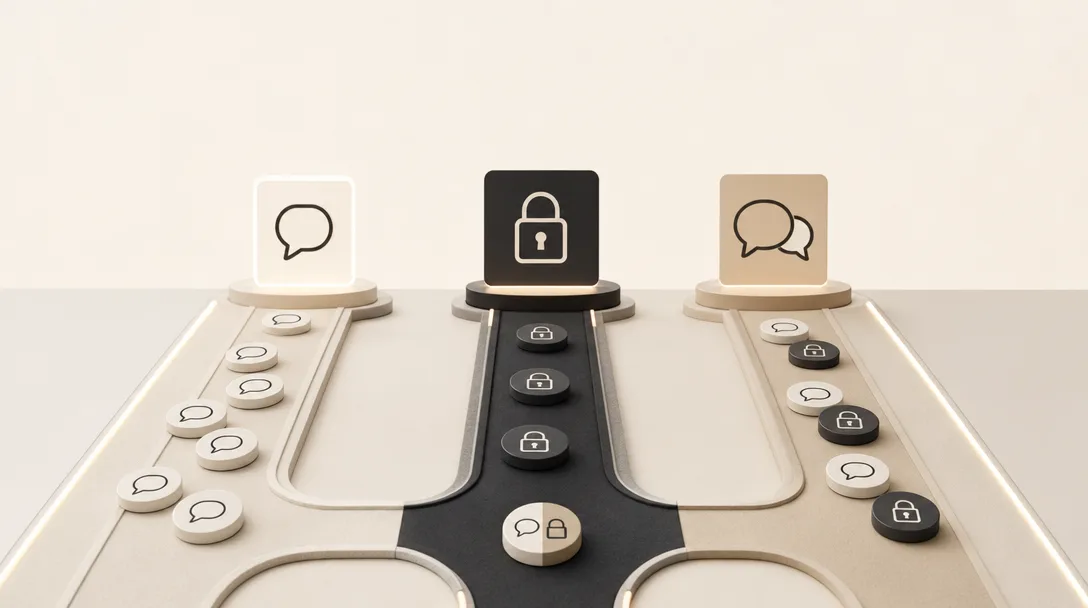
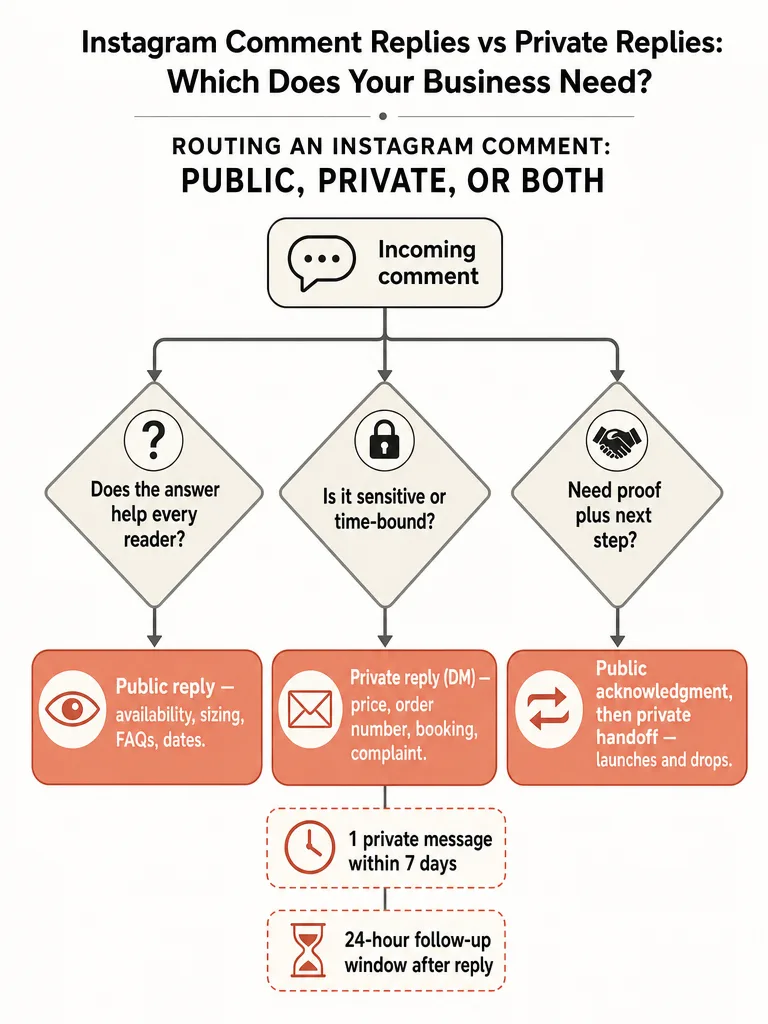
Public replies work best for questions that repeat across many readers and carry no sensitive detail: availability, sizing, dates. Private replies suit order-specific or sensitive details: prices, bookings, complaints. A hybrid handoff, acknowledging publicly and then continuing privately, fits launches and product drops. That's the practical split behind instagram comment replies vs private replies for most businesses.
A public comment reply posts directly under the original comment, visible to anyone who can see that post. A private reply moves the same conversation into the commenter's direct messages, visible only to the two of you. Instagram comments are public by default, while a private reply to a comment is itself a direct message, according to Maxbound's breakdown of Instagram's comment-to-DM mechanics.
A comment lives on the post, and anyone scrolling past, including competitors and future buyers, can read it for as long as the post stays up. A private reply behaves like any other direct message: it sits in a one-on-one inbox thread, and nobody in the comment section sees it or knows it happened. Meta treats comment-triggered private replies as their own feature with their own limits, which matters once a business tries to answer the same questions at scale. Getting the split wrong is the common failure: answering a price negotiation in the open thread, or burying a shipping policy answer in DMs where the next ten people asking never see it.
When should you reply to an Instagram comment publicly?
Public replies earn their keep when the same answer helps the next five people who scroll to that comment, not just the one who asked it. A guide to responding to Instagram comments for business from Delivered Social notes that a reply posted under a comment stays visible to everyone reading the thread, which makes it the right channel for information that applies beyond the original commenter.
Comment types that belong in public view:
- General availability ("Is this back in stock?" or "Are spots still open?")
- Sizing or fit ranges that apply to the whole product, not one order
- Class dates, cohort start dates, or event schedules
- Policy questions that repeat on every post: shipping zones, cancellation windows, what's included
Answering these in the open does double duty. It answers the asker, and it pre-answers the next ten comments asking the same thing on a viral Reel or a launch post, exactly the scenario where one Instagram inbox floods fastest.
A travel brand posting a hotel exterior shot and getting "what are your rates" twenty times in the comments is a public-reply case: the answer is identical for every reader, so visibility helps the business, not just the one guest asking. Keeping it in the thread also builds visible proof that the account is active, which readers weigh before they ever send a DM.
When should a business move an Instagram comment to DMs instead?
Private replies fit the details that shouldn't sit under a post: prices for custom work, order numbers, bookings, and complaints. A breakdown of replying to Instagram comments via DM from Maxbound notes that private messages suit information specific to one person or one transaction, rather than something every thread reader needs.
Comment types that belong in DMs:
- Price negotiations or quotes tied to one customer's specifics
- Order numbers, tracking details, or anything identifying a purchase
- Booking confirmations with dates, names, or payment details
- Complaints, refund requests, or anything that could turn into a public dispute
Moving a complaint to DMs isn't about hiding it. It keeps a frustrated customer from performing their frustration for an audience, and it gives the business room to ask clarifying questions without a crowd grading every reply. Order-specific questions follow the same rule: a sizing question is public, but asking where order #4482 is stays private, every time.
How do you send a private reply to an Instagram comment, and what are the limits?
Sending a private reply means tapping the message icon next to a specific comment and writing a direct message instead of a public response. Meta caps how far that conversation runs without the commenter replying first: one private message within 7 days of the original comment, then a 24-hour window to continue once the person answers, according to Maxbound's breakdown of Instagram's comment-to-DM rules.
- Open the comment thread on the post and find the comment to answer privately.
- Tap the message icon under that comment, not the public reply field. This opens a DM pre-loaded with a reference to the original comment.
- Send one message within the 7-day window. That's the only private reply Meta's rules allow without a response from the other side.
- Wait for the commenter to reply. Once they do, a 24-hour window opens to continue the conversation.
- If 24 hours pass without another reply, the thread closes until the commenter messages again on their own.
Meta allows one private reply within 7 days of a comment, then a 24-hour window after the commenter answers. These two windows are what the available sources confirm. Current official Meta documentation on edge cases, like differences by account type or region, isn't fully covered here, so verify those directly rather than assume. For a closer look at current Meta rules for comment automation, see Meta's comment automation rules explained.
Public comment, private reply, or both? The hybrid handoff for launches and product drops
The hybrid handoff answers a comment publicly first, then moves the real details into a private reply. A comparison of public and DM-based comment automation from CreatorFlow describes this as a practical default for launches: a short public acknowledgment keeps the thread looking active, and the private follow-up carries pricing, sizing, or booking specifics that don't belong under the post.
- Reply publicly with something that confirms the person was heard: a one-line fact true for everyone ("still available, sizing below the photo").
- Send a private reply inside Meta's 7-day window with the specific detail: exact price, the size left in stock, the booking link.
- Let the public thread keep collecting visible activity. Every acknowledgment under a launch post or viral Reel tells the next reader the account is responsive, without anyone reading the actual DM.
- Flag anything that needs a human directly: a complex custom order, a refund, or a question that doesn't fit the pattern.
Handling the public half well doesn't guarantee the private half gets done. The acknowledgment and the follow-up DM are two separate actions, often run on two separate tools, and a launch plan should assign both instead of assuming one covers the other.
Do ads and organic posts follow the same public-vs-private rules?
Organic posts and paid ads don't automatically follow identical comment rules, but the sources available for this article confirm the public-versus-private mechanics only for organic feed posts and Reels, not for ad comments specifically.
What isn't confirmed here is whether Meta's private-reply windows, or any ad-specific restriction, change once a comment sits under a paid placement. Businesses running campaigns alongside organic posting should treat ad-comment behavior as a separate question to check directly in Meta's current ad and Page tools, rather than assume the organic rules carry over unchanged. Public detail on this distinction is limited as of this writing.
How to choose between public replies, private DMs, and automated control
Choosing between public replies, private DMs, and automation depends on two things: how often a question repeats, and how sensitive the answer is. Recurring, non-sensitive questions, fixed list prices, sizes, booking slots, shipping, and policies, are worth answering the same way every time. Anything involving a negotiated price, a specific order, or a complaint belongs in review or DMs, not on autopilot.
- List the five most repeated comment questions from the last month. Fixed list price, sizes, booking, availability, enrollment, and shipping usually top it.
- Sort each into "safe to answer the same way every time" or "needs a human read every time." A public price FAQ sits in the first bucket; a negotiated quote or a refund dispute sits in the second and should move to DMs.
- For the first bucket, decide between sending automatically and holding drafts in an approval queue while trust in the output builds.
- For the second, set exclusion phrases or per-post rules that pull sensitive comments out of any automatic flow regardless of wording.
- Keep basic spam filtering active in either mode, so scam links and crypto bait never reach a live reply.
ReplyMagic is one example of a tool built around that split. New accounts start in a review-first mode, where every draft waits for a human to edit, send, or skip it before anything posts. Replies draw on the comment alongside the post's own caption and saved details, which keeps an answer about "this one" tied to the item actually shown. Once a business trusts the obvious answers, specific question types can move to automatic sending while others stay in review. The free plan includes 30 AI replies per month on one Instagram account, and the Pro plan includes 3,000 replies a month for $29.99 monthly or $249 billed yearly, according to pricing listed on ReplyMagic's site. ReplyMagic answers public comments; it doesn't run DM campaigns or handle live booking.
Public reply automation or DM funnels: which fits your Instagram strategy?
Public-reply automation and DM funnels solve different problems on the same platform. Public-reply tools keep the conversation visible, posting an answer under the comment for every future reader. DM funnels pull a commenter into a private sequence once a trigger word matches, then run a scripted conversation nobody else in the thread can see.
Both categories include tools that fire on a simple keyword match and tools that read more of the post before answering. Which one a business buys determines how much context the reply actually uses, and that difference matters more than the category label.
| Factor | Public-reply automation | Keyword-triggered DM funnel |
|---|---|---|
| Visibility | Answer stays under the post for every future reader | Answer moves to DMs; the thread shows only a trigger word |
| Trigger | Ranges from a simple keyword match to the comment plus the post itself, depending on the tool | Keyword or phrase in the comment text |
| Best fit | Repeated public questions: price, sizes, dates, policies | Lead capture and scripted multi-step sequences |
| Audience sees result | Yes, visible proof of an active account | No, the exchange happens entirely in DMs |
Neither category replaces the other. A business running a launch often wants both jobs covered: a visible answer for the crowd reading the comments, and a private sequence for the people ready to buy. The known failure point, in either category, is a tool that fires on a matched word without checking whether that word fits the actual post.
For a closer comparison of AI-drafted comment replies against keyword-triggered responders, see how AI comment replies compare to keyword auto-responders for conversions. For the setup steps behind a public-reply system that still sounds like one person wrote it, see how to set up Instagram comment auto-replies that sound like you.
Frequently asked questions
Is a private reply better for sales than a public comment reply on Instagram?
Not automatically: it depends on what the reply reveals. Private replies work better for price-sensitive details, like a negotiated quote or a booking confirmation, because granting a discount in the open thread invites every other commenter to ask for the same one. A hybrid approach: a short public acknowledgment plus a private follow-up with the exact price or size: keeps the thread active while protecting that detail. Sales results come from matching the channel to the information, not the channel alone.
Can you automate private replies to Instagram comments the same way you automate public replies?
Not easily, and not with every tool. Meta limits private replies to one message within 7 days of the original comment, then a 24-hour window once the commenter responds, which caps how far automation can run without a human reply in between. ReplyMagic, for example, drafts and sends public comment replies only; it doesn't run DM campaigns, live booking, or automated private-reply sequences. Treat public comment automation and private follow-up as two separate workflows.
What happens if an Instagram commenter doesn't respond within the 7-day private reply window?
The private thread closes and doesn't reopen until the commenter messages the business again on their own. Meta allows one private reply within 7 days of the original comment, and if that single message goes unanswered, there's no second attempt inside that window. Once the commenter does reply, a new 24-hour window opens for continuing the conversation, and that window also closes for good if nobody replies again before it lapses.
Do Instagram Story replies follow the same public-vs-private rules as comments on a feed post?
No, Story replies and feed comment replies work differently. A Story reply typed into the message bar always lands as a private direct message visible only to the Story's creator, regardless of who else viewed the Story. Feed post comments default to public and only become private once someone taps the message icon under that specific comment. Public Story comments are a separate feature, limited to about 60 characters and gone when the Story disappears after roughly 24 hours.
How much does it cost to automate public Instagram comment replies with ReplyMagic?
The free plan includes 30 AI replies per month on one Instagram account, with no credit card required. The Pro plan raises that to 3,000 replies a month for $29.99 billed monthly or $249 billed yearly, also on one account. ReplyMagic answers public comments only: it doesn't send DMs, manage live bookings, or run private-reply campaigns, so the pricing covers comment automation specifically, not the full inbox.
What goes wrong with keyword-triggered auto-replies on Instagram comments?
A keyword auto-reply fires whenever a comment contains the matched word, whether or not that word fits the actual post, which produces replies that read as obviously automated or flatly wrong. Answering a price question under a post that never mentions price is the common failure. Context-aware replies reduce that risk by reading the comment alongside the post's caption and saved details before drafting, answering what the post actually shows instead of matching a trigger phrase.